Despite being a close relative language to English, German has its notable differences, in this project's case, having significantly less tokens compared to the English and Aracbic translations, so why is that a thing in the first place?
How German adjectives is similar to English, but with the difference being the requirement of an ending, and they change ends depending on the factors. These factors being that German adjectives have to accomodate for the gender, case, and number of where they are placed in the noun. Since this is a factor, most words might get picked up mutiple times and mean the same thing, with the only difference being an 'e', 'en', 'es, 'em, or 'er' ending.
Let's take the word "Legendär" for example, the adjective was picked up three different times on the 100 adjective list, despite all meaning "Legendary" in the same format. The reason it was picked up in some cases was because of the endings, the most noticable usage was "legendär", second being "Legendären", and the last being "Legendär". These three all mean "Legendary", so why are they marked as different? Based on where they are in the dialogue of the game, that's why it's considered different, even though the first and third instances are the exact same, the context and placement in a sentence makes it different to stand out to the corpuses.
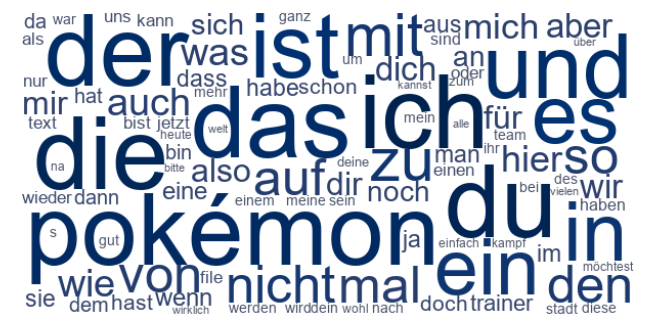
Most common words were either the genders, "der", "die", and "das", plural nouns like "Pokémon", prepositions like "auf", "an", and "für", or dative case words like "mich", "dich", and "uns"
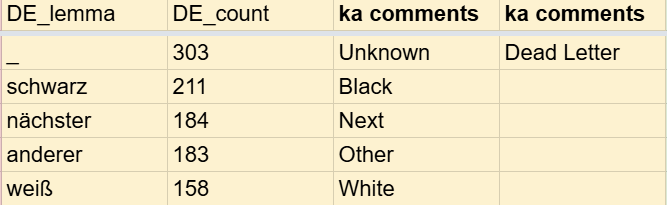
Something I noticed when looking at the list was the strange amount of either dead letters or just out-of-place words I saw. If you look really closly in the image above, the word "file" can be seen. File is not an adjective nor somewhere that would be a common occurence in the game. These strange words appearing were from the translation not carrying over correctly. The "Text File" words wouldn't disappear for the German translations, but would for the Arabic translations. Something in one of those translators made it easier to filter through placeholder text compared to the game files from the corpus from the German translation.
Not only were strange letters and phrases slipping through the corpus's cracks, but common words that were just the game's title or words that weren't adjectives were sliding though as well, and they were the first few in the top 100 analysed.
Just like English, German has multiple words that mean the same thing, but in this case, it just depends on the context of the sentence, and looking at the corpus results, it shows those different uses. An example being "schön" and "wunderschön", both mean beautiful but are used in different contexts.
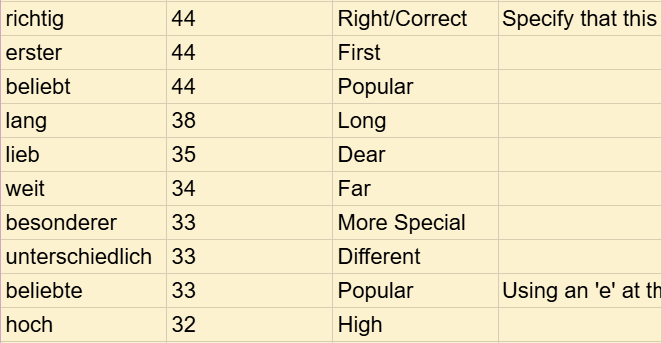
Another instance of case endings causing the corpus to read multiple, with "beliebt" and "beliebte"
Some of these adjectives becasue they were detected differently, appear in different orders according to the tokens on the other half of the Google document. Take for instance "legendär" on the first one, legendär was marked 3 times in the top 100, but in the tokens, legendär only has about 31.
There also seemed to be different varieties of words that would show up compared to the English. Disregard the misread first word in the German translated one, other words like "much", "cute", "tired", "common", "wild", and many other words were not as frequent as the English script. This could just be to word phrasing or just different ways of saying it, leading to other adjectives being used in place of those ones. For "cute"'s case, the "schön" and "wunderschön" could've taken its place, as both of these words mean "beautiful", slapping different words onto it could change up the meaning and how it is used in a sentence. This can be seen with other English to German media, where the sentences are written different, but convey the same idea. Think of it like slang but without the confusing words associated with it. Two sentences that are written different, but mean the exact same thing.
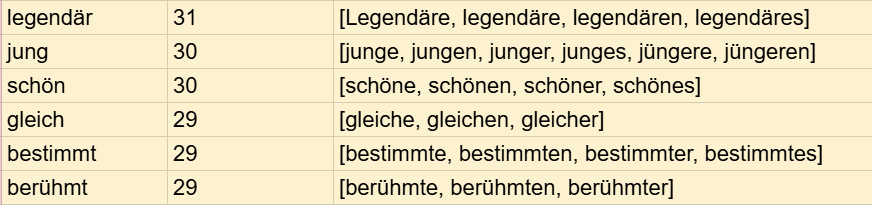
Snippit from the token readings on adjectives, legendär has only 31, showing the different variations it has due to sentence structuring and gender.
Seeing how different corpuses picked up different results, it was interesting to see which ones would pick up the same words, and for a few runs through, the similar words with changed endings were picked up as the same word. Depending on which corpus you use, the variety of top results can vary. The German seemed very similar to the English translation's results if you were to take away the different endings messing things up and the "Text File" slips.
English to German could mean the same thing but just written in a different style, most likely to not disrupt the structuring of German sentences. These senteces could mean the same thing as English, but just expressed and said differently, leading to different adjective detection.


